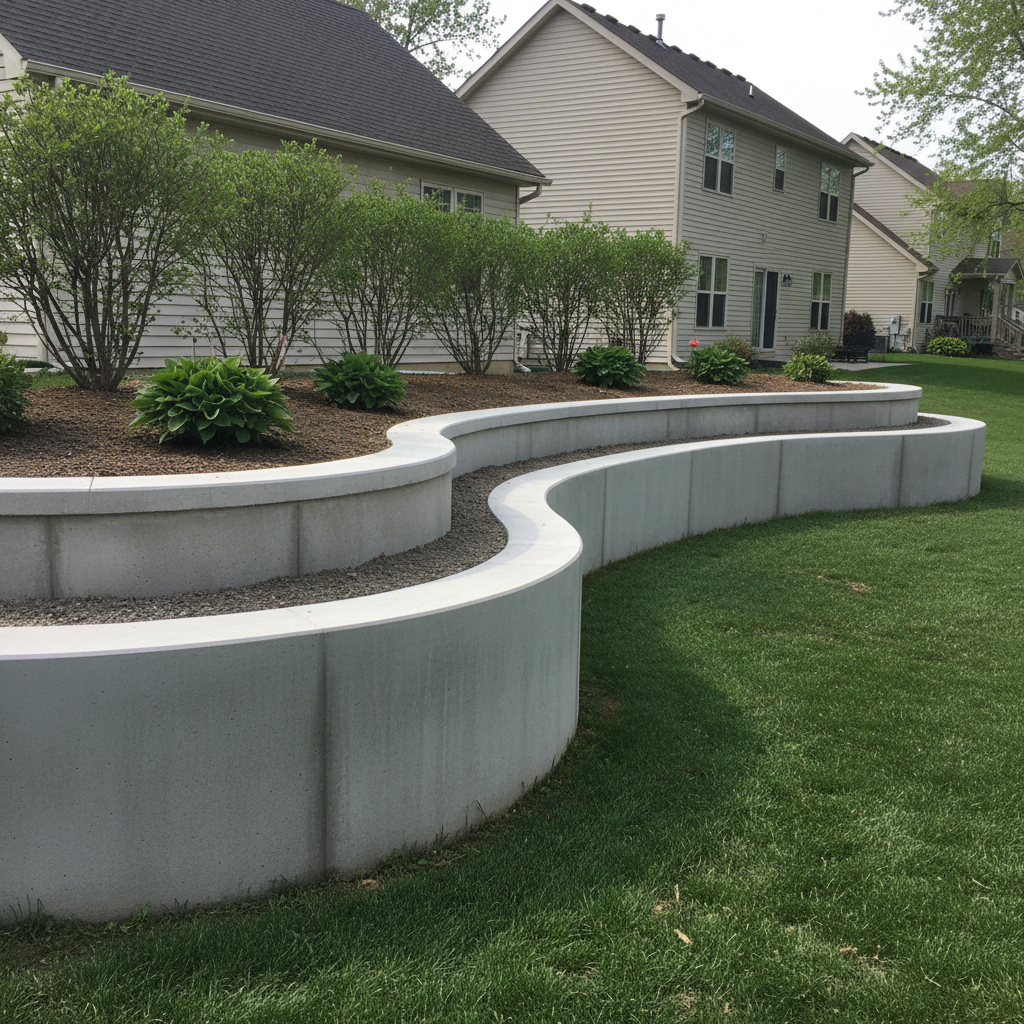
So, you need a retaining wall. Maybe your yard's got a slope that's washing out, or you're trying to create some usable flat space. A concrete retaining wall is a solid choice, literally, but you're probably wondering what it's going to hit your wallet for. Let's talk real numbers.
What Makes a Concrete Retaining Wall Cost What It Does?
A lot goes into pricing these things, more than just the concrete itself. Here's what I look at when I'm putting a quote together:
- Size and Height: This is a no-brainer. A bigger, taller wall needs more material, more labor, and often, more engineering. A 2-foot high garden wall is a totally different beast than a 6-foot structural wall holding back a hillside.
- Wall Type: Are we talking about a simple gravity wall, a cantilevered wall with a footing, or something more complex like a segmental block wall with concrete infill? Poured concrete walls are generally more expensive upfront than modular block walls, but they offer superior strength and longevity. For this post, I'm focusing on poured concrete or concrete block walls that require a proper footing and rebar.
- Site Access: Can we get a mini-excavator and a concrete truck right up to where we're working? Or do we have to hand-dig and wheelbarrow everything in because it's in a tight backyard with no gate access? That's a huge factor in labor hours. If we're hauling dirt out of a tight spot in a typical Ranch-style home backyard in Schaumburg's older neighborhoods, that's going to add to the cost.
- Soil Conditions: This is a big one, especially around here. We've got a lot of clay soil in Schaumburg. If the soil's unstable or has poor drainage, we might need more extensive excavation, a deeper footing, or even a specialized drainage system behind the wall. That means more material and more time.
- Drainage Requirements: Any good retaining wall needs proper drainage. We're talking about gravel backfill, perforated pipes (weep holes), and sometimes even geotextile fabric. Ignoring drainage is asking for trouble down the road, and it's an essential part of the cost.
- Reinforcement: For anything structural, you're going to need rebar. The amount and size of rebar depend on the wall's height and the load it's holding. More steel means more material cost and more labor to cut and tie it.
- Finishing: Do you want a plain concrete finish, or are we going to stamp it, color it, or apply a veneer? Each of those adds to the material and labor costs.
- Permits and Engineering: For taller or structural walls, you'll absolutely need a permit from the Village of Schaumburg, and likely a structural engineer's design. This isn't optional; it's for safety and compliance. Those costs are usually separate from the construction itself but are part of the overall project.
Typical Cost Ranges for Concrete Retaining Walls in Schaumburg
Alright, let's get to some numbers. Keep in mind these are estimates, and every project is unique. These prices generally include excavation, forming, rebar, concrete, backfill, and basic drainage, but *not* engineering or permits unless specified.
- Smaller, Non-Structural Walls (2-3 feet high): For something like a garden border or a small terraced area, you're probably looking at $45 to $75 per linear foot. This is for a relatively straightforward, poured concrete wall.
- Mid-Sized Structural Walls (4-6 feet high): This is where most residential retaining walls fall. Expect to pay anywhere from $80 to $150 per linear foot. At this height, engineering and permits become much more likely, adding $1,500 to $4,000+ to the total project cost.
- Larger, Complex Walls (7+ feet high): These are serious projects. Costs can easily jump to $160 to $250+ per linear foot, and engineering is mandatory. You might also need specialized equipment or techniques, driving up the price.
So, for a 50-foot long, 4-foot high structural retaining wall, you could be looking at $4,000 to $7,500 for the construction alone, plus the engineering and permit fees. That's a pretty common scenario for a lot of homes around here.
What Should Be Included in a Quote?
When you get a quote from Absolute Concrete Co., or anyone else, make sure it's detailed. It should clearly spell out:
- Excavation: Depth, width, and disposal of spoil.
- Footing: Dimensions, depth, and rebar schedule.
- Wall Dimensions: Height, thickness, and length.
- Reinforcement: Type, size, and spacing of rebar.
- Concrete: PSI strength, quantity, and delivery.
- Formwork: Materials and labor for building the forms.
- Drainage: Gravel backfill, perforated pipe, weep holes, and filter fabric.
- Backfill: Type of material and compaction.
- Labor: Hours and rates for the crew.
- Cleanup: What's included in site restoration.
- Warranty: What kind of guarantee they offer.
If a quote just says